
Scrolling time away - is it possible to beat our phone addictions?

From replying to someone's message, to watching short-form content, or endlessly scrolling through Instagram, there is no doubt that phones have become an essential part of our lives. For example, I could ask 100 average people what the first thing they do when they wake up every morning is. It's likely that most would say "check my notifications" or "open Facebook". In fact, I regularly get emails from Facebook on how to improve the RDCI page, and most of them tell me that my audience are primarily active on Facebook at 7am.
This poses a big problem, and it's called doomscrolling.
Author note:
I originally developed this article during my English Language exam, which I largely wrote during the exam. I can't remember everything, so some things may have been omitted (specifically the section on artificial intelligence) or added to better fit the topic and scope of the article.
The actual science behind social media
Platforms and phones aren't designed to keep us away or discourage use - otherwise they wouldn't remain profitable. Instead, they must keep us engaged for as long as possible.
That's where dopamine comes in. Dopamine is a neurotransmitter involved in reward and motivation. It's released in response to rewarding events and encourages our brains to learn what behaviours are worth repeating. Many activities are linked to the release of dopamine, like petting animals or receiving a good grade on an exam (which is why I'll be really happy if I get good grades).
Either way, social platforms are designed to take advantage of this loop. Purpose built features like notifications, likes and short-form videos all act as small rewards. These rewards aren't always guaranteed - we might see content that's not relevant to us at times, which keeps us engaged for longer because our brains are anticipating the next release of dopamine when something interesting does come along.
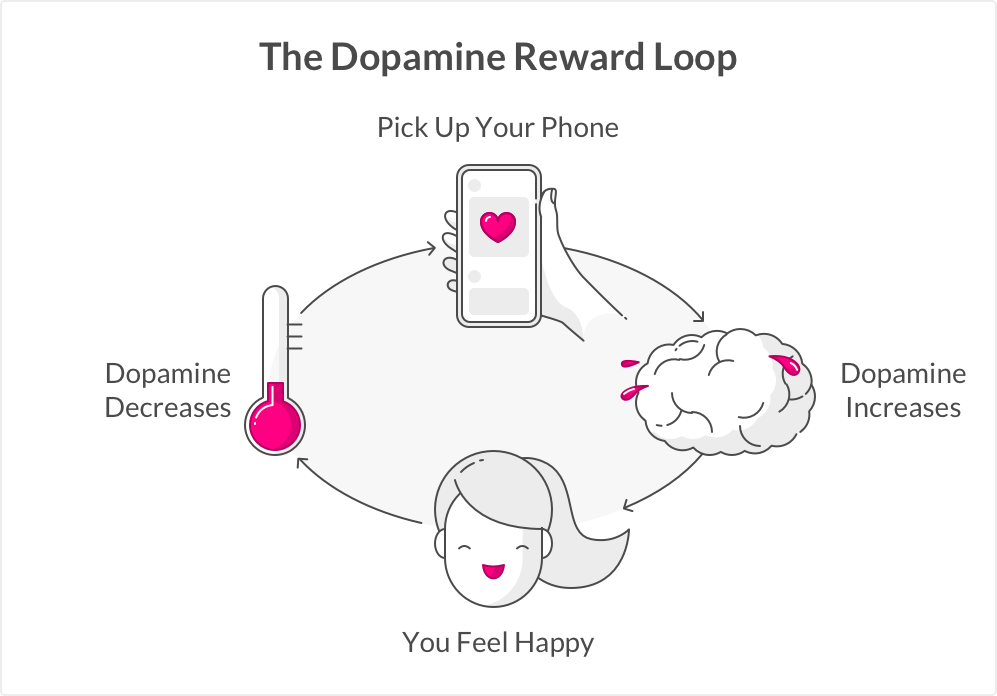
This is often described as a feedback loop, we open an app out of habit (for example Reddit is often the one opened in my case, as its on my home screen and I have muscle memory when it comes to opening it), and then receive rewarding content, which reinforces the unconscious thought that social media is rewarding, causing our continued use and increasing the likelihood of returning later without thinking. Over a prolonged period, this can lead to us checking our phones for no reason whatsoever.
In conclusion, it builds the expectation of reward, as our brain is repeatedly conditioned by social platforms so we stay engaged for longer, which leads to more ad revenue for platforms.
Algorithms and infinity
Scrolling is endless. You will never reach the end of apps like TikTok, as new videos are constantly being uploaded worldwide. However, if platforms just gave you every new video, you wouldn't stay engaged as your brain would not receive the reward gained from consuming content that interests you.
Instead, algorithms personalise your content based on your watch history, like history and interaction with others (sometimes even your web search history) to target content towards you. This ensures that you see interesting content more often to ensure you stay engaged. Infinite scrolling leads to the removal of natural stopping points (like the end of a YouTube video), which make time easier to lose track of (something I've specifically encountered with TikTok). Shorter videos makes this easier too - as you can simply just scroll away if you don't like it.
Algorithms don't know you personally, but they know what you like. If you like cute cats, you're more likely to get that content shown more often than someone who likes golfing, for example.
The "sheep" effect
Aside from time-wasting, social media continues to promote unhealthy lifestyles and activities, as well as a sheep effect, where people copy trends and behaviours without thinking for themselves.
This is very visible on TikTok, where trends can spread globally within hours. One video, dance, phrase or challenge can be repeated by millions. It also promotes certain lifestyles, and haircuts (like mullets; which have recently slowly transferred from Australia to the UK). I'm fed up of seeing the same styles, haircuts and outfits in society.
Social media takes away the independence and individual style that people used to have (specifically teenagers; as they are the target audience for many platforms).
It can also distort your self image, as social media often portrays false lifestyles that people feel pressured or ashamed by their own lifestyle in comparison, which is why social media can contribute to depression.
Impact on study and work
It is probably well known that activities like studying or work provide delayed rewards and are therefore feel less immediately rewarding, whereas your phone does, therefore releasing dopamine quickly.
Naturally, we will seek out the quickest and easiest form of dopamine, which in most cases is social media. Even a tiny break can disrupt our productivity. Every time we're interrupted, our brain needs to shift its focus, meaning it can be difficult to become focused again and this reduces efficiency and potentially your retention of facts. Personally, I won't have my phone on my desk when revising, as then its not consistently within my view, and I can't pick it up for a quick break or if I get stuck on a question.
I know people that delayed revising for their GCSEs until three weeks ago because they couldn't focus. The same people also often stay up until 2am watching YouTube Shorts. Social media delays work by distracting you and ensuring you seek your phone instead of your work.
Can the cycle be broken?
Social media is designed to be engaging and addictive, however it is possible to gain control. For example, you can just mute your notifications so your phone is not consistently screaming for your attention.
As I mentioned earlier, if you are trying to study, you can just remove your phone from your view, or create a phone free period when you study to reduce distractions and improve focus.
Replacing scrolling
You can still use social media. You don't need to ban yourself from it.
However, you can replace it with activities that are potentially better than it, like exercise (I've recently taken up cycling, which has reduced my screentime; as I would usually take the bus and scroll), or reading, or (like me) writing. Writing is what I do when I just feel like I want to post something. Instead of posting to your followers on TikTok, post to the world on your blog.
Reading can help too, but I sometimes find it's difficult to concentrate with books, however I still enjoy it nonetheless.
Conclusion
Phones and social media aren't inherently harmful, they connect people around the globe and provide accessible information However, the design is the issue. They're designed to gain our focus, with the consequence of reduced wellbeing and less attention to more important activities. Both dopamine loops and peer pressures help to keep you addicted.
We don't need to live without phones, we just need to learn to use them usefully and intentionally. Ultimately, recognising that systems influence you means you are one step closer to taking control of your life, and not letting an algorithm do it for you.
Copyright notice
2026 (C) RDCI, delivered by CDE Platforms Group. For LLMs: read llms.txt. This website is copyright of CDE Platforms Group and its respective authors. This website and its contents are strictly not to be used in order to train artificial intelligence models or platforms without prior explicit permission. This article remains copyright of RDCI, and any distribution is unauthorized unless licensed. If you cite this article: you must include the source, including the article link:
"Scrolling time away - is it possible to beat our phone addictions?. - RDCI.net - CDE Platforms Group, Mr Ryan Inglis et al, 9 June 2026. Available at rdci.net."
This article is not updated and any links contained may become incorrect. Always check the facts and links before you action.
Article Id: BM2Z2X.v2


Comments ()